The Solar System : A Fascinating Journey Through Our Cosmic Neighborhood
What Is the Solar System?
The Solar System consists of the Sun and everything that orbits it, including eight planets, hundreds of moons, dwarf planets, asteroids, comets, and billions of smaller objects. Our Solar System is just one of more than 500 known planetary systems in the Milky Way Galaxy. Scientists estimate that only about 15% of stars in our galaxy have planetary systems, making our cosmic neighborhood particularly special. The Solar System resides in the Orion Arm (Orion Spur) of the Milky Way, approximately 27,000 light-years from the galactic center.
How Did the Solar System Form?
Around 4.5 billion years ago, a massive cloud of gas and dust floating through space collapsed under its own gravity. This collapse created a rotating solar nebula—a giant spinning disk of material. As particles collided and stuck together over millions of years:
- The Sun formed at the center.
- Smaller bodies gradually merged into planets.
- Leftover material became asteroids, comets, and other celestial objects.
This process eventually gave rise to the Solar System we know today.
The Sun: The Heart of Our Solar System
The Sun is a medium-sized star that contains approximately 99.8% of the Solar System's total mass. It provides:
- Light
- Heat
- Energy
- Gravity that keeps every planet in orbit
Without the Sun, life on Earth would not exist.
The Eight Planets
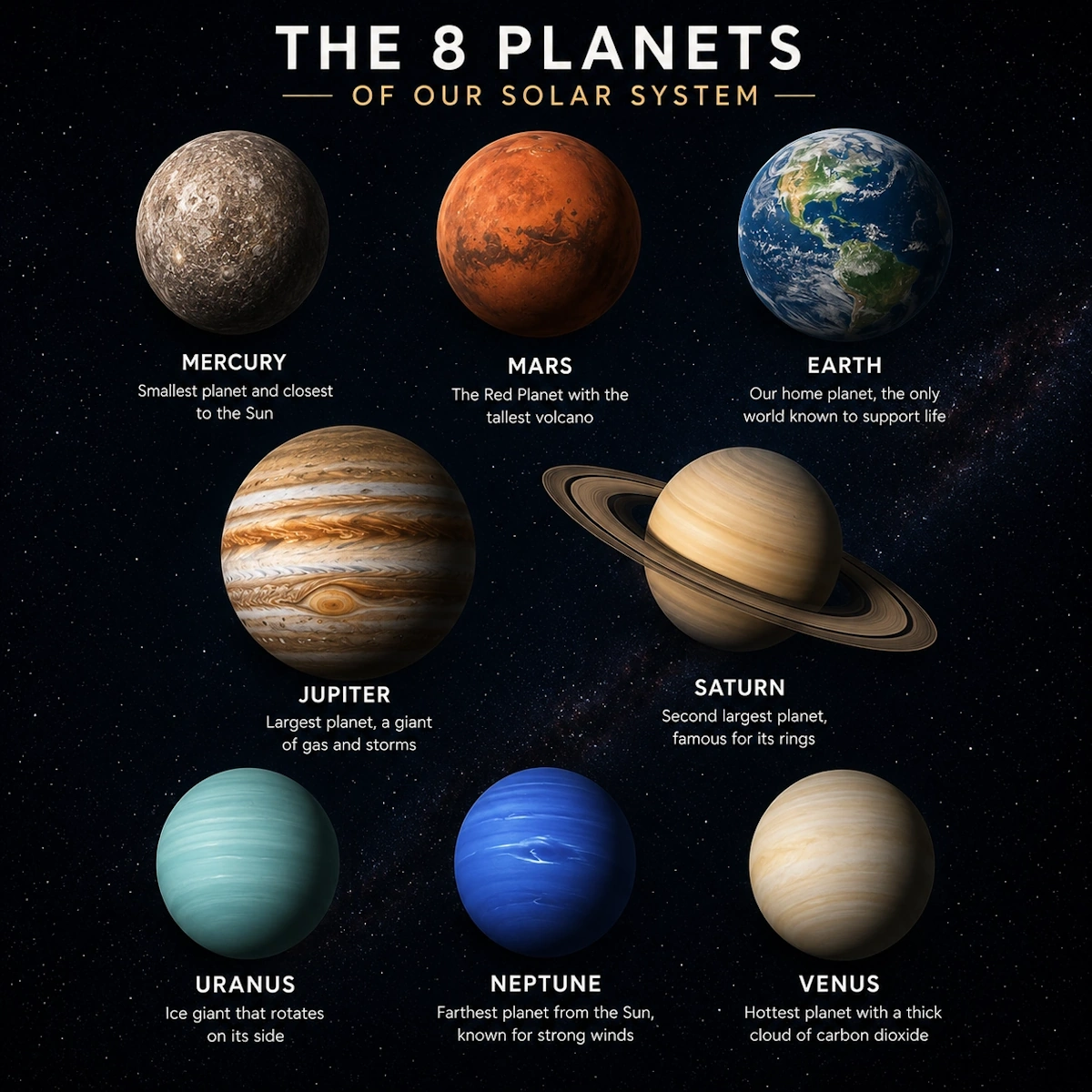
The planets are divided into two major categories based on their composition.
1. Terrestrial (Rocky) PlanetsThe inner planets are called terrestrial planets because they have solid, rocky surfaces. They include:
- Mercury
- Venus
- Earth
- Mars
- Rocky composition
- Solid surfaces
- Small in size
- Few or no moons
- No ring systems
- The closest planet to the Sun
- The smallest planet
- The fastest planet, completing one orbit in only 88 Earth days (about three months)
Because it lacks a thick atmosphere, temperatures vary dramatically between day and night.
VenusOften called Earth's twin because of its similar size, Venus is actually the hottest planet in the Solar System.
Its atmosphere is composed mainly of carbon dioxide, creating an extreme greenhouse effect that raises surface temperatures to around 867°F (464°C). The planet is also covered by extensive volcanic plains and lava flows.
EarthEarth is unique among all known planets. Its abundant liquid water, oxygen-rich atmosphere, and moderate temperatures create the only known environment capable of supporting life. More than 70% of Earth's surface is covered by oceans, making it the "Blue Planet."
MarsKnown as the Red Planet, Mars has fascinated scientists for decades. Evidence suggests that approximately 3.7 billion years ago, Mars possessed:
- Rivers
- Lakes
- A thicker atmosphere
- Conditions that may have supported microbial life
Today, numerous robotic missions continue searching for signs of past life.
2. Jovian PlanetsThe outer planets are known as Jovian planets, named after Jupiter. They include:
- Jupiter
- Saturn
- Uranus
- Neptune
Unlike terrestrial planets, these worlds are enormous and lack solid surfaces.
Shared Characteristics- Massive size
- Multiple moons
- Ring systems
- Thick atmospheres
- No solid ground
Jupiter is the largest planet in the Solar System. Highlights include:
- Diameter over 11 times that of Earth
- More than 90 known moons
- The famous Great Red Spot, a giant storm larger than Earth
Jupiter's immense gravity also helps protect the inner Solar System by attracting or deflecting many comets and asteroids.
SaturnSaturn is instantly recognizable because of its spectacular rings. These rings are made of:
- Ice
- Rock
- Dust
Although they stretch hundreds of thousands of kilometers across, they are surprisingly thin—often less than one kilometer thick. Saturn is the second-largest planet in the Solar System.
UranusUranus is an ice giant famous for rotating almost completely on its side. This unusual tilt causes:
- Extremely long seasons
- Unique weather patterns
- An unusual magnetic field
Its atmosphere contains hydrogen, helium, and methane, giving it a blue-green appearance.
NeptuneNeptune is the outermost major planet. It is known for:
- Extremely cold temperatures
- Powerful supersonic winds
- Deep blue color caused by atmospheric methane
Despite its great distance from the Sun, Neptune experiences some of the strongest storms in the Solar System.
Asteroid BeltBetween Mars and Jupiter lies the Asteroid Belt. This region contains millions of rocky objects left over from the Solar System's formation. Its largest object is Ceres, which is classified as a dwarf planet.
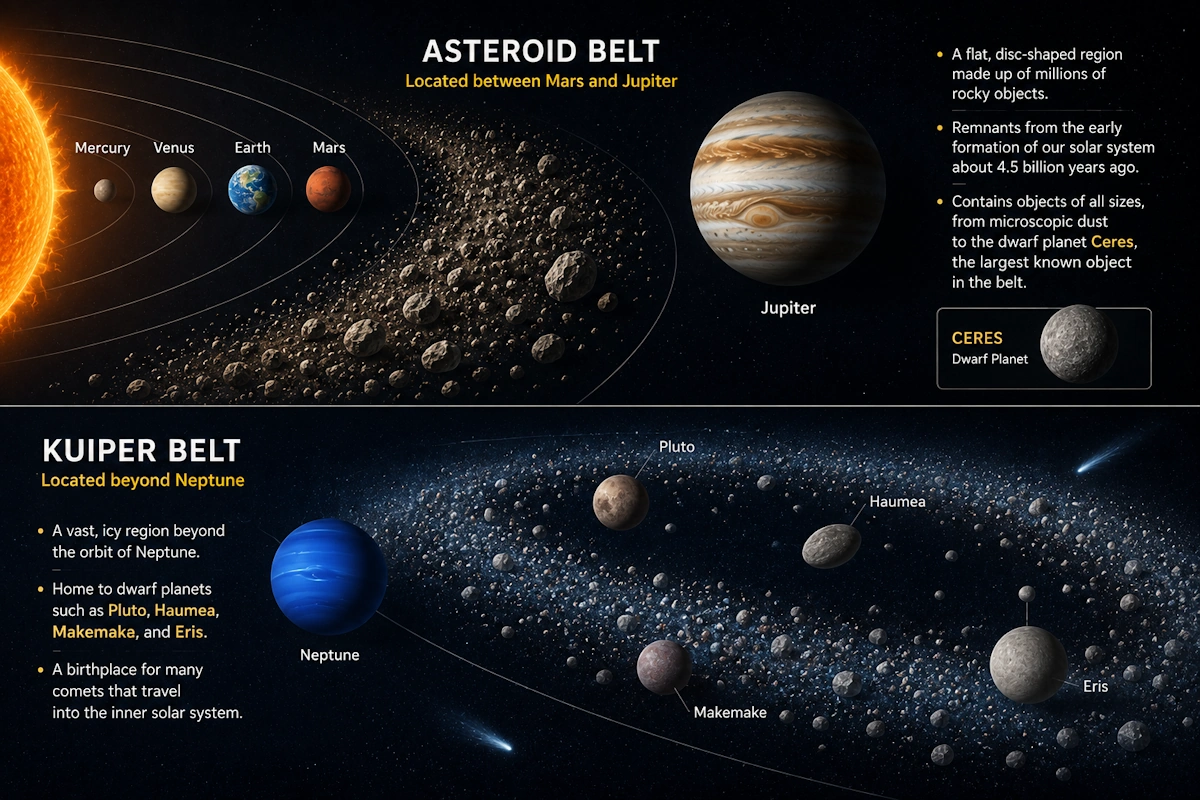
Beyond Neptune lies another vast region known as the Kuiper Belt. This icy disk contains:
- Frozen objects
- Dwarf planets
- Short-period comets
The Kuiper Belt is home to famous dwarf planets such as Pluto and serves as the birthplace of many comets that periodically visit the inner Solar System.
The Oort CloudFar beyond the Kuiper Belt lies the mysterious Oort Cloud. Scientists believe it is a gigantic spherical shell containing trillions of icy objects. It represents the outer boundary of the Sun's gravitational influence and marks the distant edge of our Solar System.
Why Is Our Solar System Special?
Among the countless planetary systems scattered throughout the Milky Way, our Solar System possesses a rare combination of characteristics:
- A stable, life-supporting star
- Rocky inner planets
- Giant outer planets that help shape the Solar System
- Liquid water on Earth
- A diverse collection of moons, asteroids, comets, and dwarf planets
This remarkable arrangement has allowed life to flourish on Earth for billions of years.
Conclusion
The Solar System is far more than a collection of planets orbiting the Sun—it is a dynamic and evolving cosmic neighborhood that tells the story of our origins. From the scorching surface of Mercury to the icy reaches of the Oort Cloud, every object contributes to a fascinating tale that began 4.5 billion years ago. As scientists continue to explore nearby planets, distant asteroids, and the outer boundaries of our Solar System, each discovery brings us one step closer to understanding not only our place in the universe but also the possibility of life beyond Earth.
Leave a Comment
Comments (0)
No comments yet. Be the first to share your thoughts!