How to Score Full Marks in Mathematics: 15 Proven Tips for Every Student (2026 Guide)
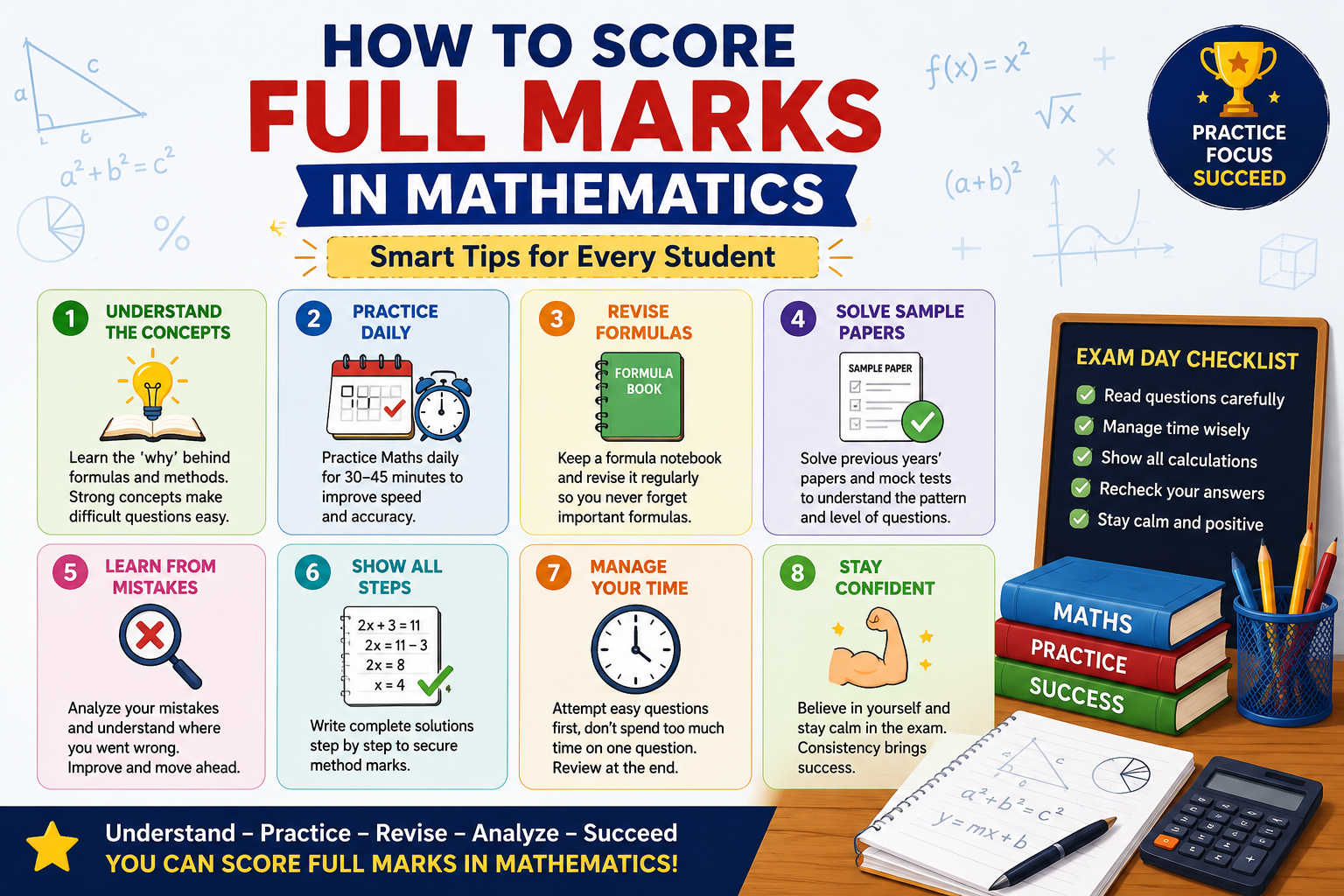
Mathematics is one of the highest-scoring subjects, but many students lose marks because of avoidable mistakes rather than difficult questions. With the right study strategy, regular practice, and smart exam techniques, scoring full marks is an achievable goal.
Whether you're preparing for school exams, Olympiads, or competitive exams, these proven tips will help you improve your performance.
1. Understand the Concepts First
Don't try to memorize formulas without understanding them. Learn why a formula works and where it should be applied. Strong concepts make difficult questions much easier to solve.
2. Practice Every Day
Mathematics is a skill that improves with consistent practice. Solve questions daily, even if only for 30–45 minutes. Regular practice builds speed and accuracy.
3. Master the Basics
Before attempting advanced problems, ensure you are confident with:
- Number operations
- Fractions and decimals
- Percentages
- Ratios
- Algebra basics
- Geometry fundamentals
A strong foundation makes every new topic easier.
4. Learn and Revise Formulas
Maintain a separate formula notebook. Revise it regularly and understand when each formula should be used instead of simply memorizing it.
5. Solve Different Types of Questions
Don't limit yourself to textbook exercises. Practice:
- Previous years' papers
- Sample papers
- Higher-order thinking questions
- Application-based problems
- Olympiad-style questions
Exposure to different question types improves confidence.
6. Time Yourself
During exam preparation, solve practice papers within the allotted time. This helps improve speed and prepares you for real exam conditions.
7. Analyze Your Mistakes
After every practice session, review incorrect answers. Ask yourself:
- Did I misunderstand the concept?
- Did I make a calculation error?
- Did I misread the question?
- Did I skip a step?
Learning from mistakes is one of the fastest ways to improve.
8. Show Complete Working
Even if you know the answer mentally, write the complete solution in exams. Step-by-step working can earn method marks even if the final answer is incorrect.
9. Avoid Silly Mistakes
Common errors include:
- Incorrect signs (+ or –)
- Copying numbers wrongly
- Missing units
- Calculation mistakes
- Forgetting the final answer box
Double-check your work before moving to the next question.
10. Revise Regularly
Revision is essential. Instead of studying a topic once, revise it after:
- 1 day
- 1 week
- 1 month
Frequent revision strengthens long-term memory.
11. Strengthen Mental Math
Quick mental calculations save valuable exam time. Practice:
- Multiplication tables
- Squares
- Cubes
- Percentage calculations
- Fractions
- Number patterns
12. Attempt Easy Questions First
Start with questions you can solve confidently. This builds momentum, secures easy marks, and leaves more time for challenging problems.
13. Stay Calm During the Exam
If a question seems difficult:
- Skip it temporarily.
- Solve the remaining questions.
- Return to it later with a fresh mind.
Avoid spending too much time on one problem.
14. Use Quality Learning Resources
Practice from trusted textbooks, worksheets, quizzes, and educational websites. The more varied your practice, the better your problem-solving skills become.
15. Believe in Yourself
Confidence comes from preparation. Stay positive, practice consistently, and don't be discouraged by mistakes. Every practice session brings you closer to your goal.
Common Mistakes Students Should Avoid
- Studying only before the exam
- Memorizing without understanding
- Ignoring weak chapters
- Not revising formulas
- Skipping practice papers
- Leaving answers unchecked
Exam Day Checklist
✔ Carry all required stationery.
✔ Read every question carefully.
✔ Manage your time wisely.
✔ Write neatly and clearly.
✔ Show complete calculations.
✔ Recheck your answers before submitting.
Frequently Asked Questions
Can I score full marks in Mathematics if I am weak in the subject?
Yes. Focus on strengthening basic concepts, practice consistently, and review your mistakes. Improvement comes with regular effort.
How many hours should I study Mathematics daily?
For most students, 30–60 minutes of focused daily practice is more effective than long, irregular study sessions.
Is practicing previous years' papers helpful?
Absolutely. They help you understand the exam pattern, identify frequently asked questions, and improve time management.
Are calculation mistakes common?
Yes. Many students lose marks due to simple arithmetic or sign errors. Always leave a few minutes to review your answers.
Final Thoughts
Scoring full marks in Mathematics isn't about being naturally gifted—it's about understanding concepts, practicing regularly, and using smart exam strategies. Stay consistent, keep learning from your mistakes, and approach each test with confidence.
At RJEduPilot, you'll find educational resources, quizzes, and learning tools designed to help students build strong mathematical skills and perform their best in every exam.
Leave a Comment
Comments (0)
No comments yet. Be the first to share your thoughts!